Apr 08, 2026
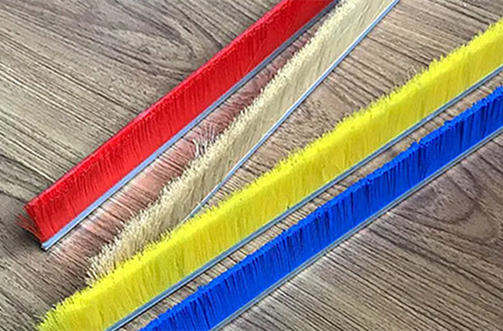
Strip Brush is one of the most widely used types of industrial brushes. It is commonly applied in sealing, cleaning, polishing, dust control, and many other industrial processes. Among all strip brush materials, nylon strip brush and polypropylene strip brush are the two most popular options.
Because they look almost identical in appearance, many buyers find it difficult to distinguish between them. However, their performance, durability, and ideal applications are quite different.
In this article, we will clearly explain the differences between nylon and polypropylene strip brushes, their best use cases, and practical identification methods. This will help you choose the right material for your application and improve efficiency.
Key Differences Between Nylon and Polypropylene Strip Brushes
1, Abrasion Resistance
Nylon strip brushes offer significantly better wear resistance than polypropylene.
Nylon has 1.5 to 4 times longer service life in most applications
It maintains performance under repeated friction and high-frequency use
Polypropylene strip brushes, on the other hand:
Have lower abrasion resistance
Wear out faster in heavy-duty environments
If your application involves continuous movement or friction, nylon is the better choice.
2, Water Absorption
Water absorption directly affects dimensional stability and performance in humid environments.
Nylon strip brush: absorbs about 3.5%–5% water
Slight expansion in wet conditions
Increased flexibility but slightly reduced strength
Polypropylene strip brush: absorbs less than 0.05% water
Excellent dimensional stability
Fast drying and resistant to mold
For wet or humid environments, polypropylene performs better.
3, Temperature Resistance
Temperature tolerance is another critical factor.
Nylon strip brush:
Can withstand 150°C to 220°C
Maintains stable hardness under normal operating temperatures
Polypropylene strip brush:
Starts to soften above 60°C
Performance decreases significantly under high temperature or strong chemical exposure
Nylon is the preferred choice for high-temperature environments.
4, Chemical Resistance
Chemical stability varies significantly between the two materials.
Nylon strip brush:
Resistant to weak acids and alkalis
Not suitable for strong alkaline environments
Polypropylene strip brush:
Excellent resistance to most acids and alkalis
Stable against most chemicals except strong oxidizing acids (e.g., concentrated sulfuric or nitric acid)
Polypropylene is ideal for chemically aggressive environments.
5, Cost
Cost is often a deciding factor in large-scale applications.
Nylon strip brush:
Higher material and production cost
Polypropylene strip brush:
More economical and cost-effective
For budget-sensitive projects, polypropylene is often preferred.
Suitable Applications
Based on the differences above, each material has its ideal use cases.
Nylon Strip Brush Applications
Due to its high abrasion resistance and temperature resistance, nylon strip brushes are ideal for:
High-frequency door sealing systems
Continuous cleaning or polishing processes
Conveyor systems with constant movement
High-temperature environments (e.g., food processing industry)
Polypropylene Strip Brush Applications
With its low water absorption, strong chemical resistance, and lower cost, polypropylene strip brushes are suitable for:
Wet or humid environments
Chemical processing areas
Low-frequency sealing applications
General-purpose dust and debris control
How to Identify Nylon vs Polypropylene Strip Brushes
Since they look very similar, here are two practical ways to distinguish them.
1, Touch and Bending Test
By touch:
Nylon bristles feel slightly textured, similar to the back side of silk
Polypropylene bristles feel smooth and slippery, like a plastic ruler
By bending:
Nylon:
Bends easily and quickly returns to its original shape
Leaves almost no crease
Maintains elasticity after repeated bending
Polypropylene:
Leaves visible creases after bending
May turn white at the bend point
Becomes brittle and may break after repeated bending
2, Burning Test (Professional Method)
This method should only be performed safely in controlled conditions.
Nylon bristles:
Shrink into small furball-like shapes when burning
Produce a blue-white flame with slight crackling sounds
Residue is hard, brittle black particles
Polypropylene bristles:
Burn with a yellow flame and black smoke
Produce a strong plastic odor
Residue is soft, sticky, and gray (similar to melted gum)
Need Expert Advice?
At BaJie Brush, we specialize in manufacturing high-quality strip brushes with customized materials, sizes, and configurations.
If you have any questions about nylon strip brush or polypropylene strip brush, feel free to contact us. Our team will provide professional recommendations tailored to your application.
Read More



 IPv6 network supported.